I’ve written about the Big Eddy Bridge before.
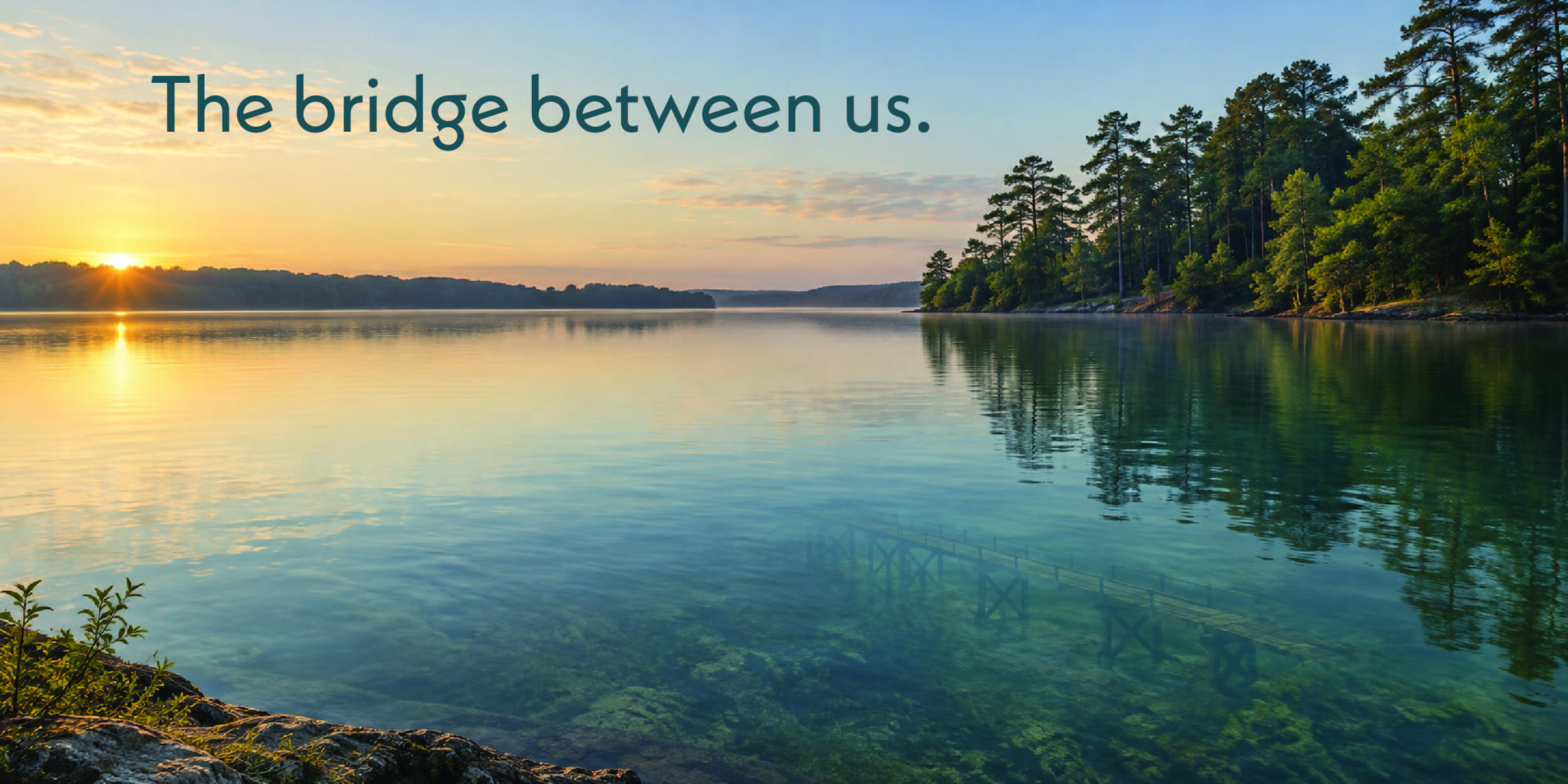
My childhood memory of the old wooden bridge, now under Lake Palestine, probably isn’t entirely accurate. But the memory is real. My brother and I would convince my dad to drive across it whenever we could. Every board seemed to slap against the tires as Dad slowly made his way across.
Sometimes he would stop in the middle and debate whether to keep going or back up to safety.
As a child, I wasn’t sure what would happen. Would we make it across? Would Dad decide the risk was too great?
When I think about the bridge, I’m reminded of a lesson about giving: donors learn over time, sometimes stopping in the middle to ask whether we know enough to continue.
But I’m beginning to see the bridge as something more—a picture of the relationship between donors and nonprofits.
Two sides of the bridge
A donor and a nonprofit often begin on opposite sides of the river.
The donor brings resources, but also a perspective shaped by what they see happening in the community. Sometimes a funder sees beyond an organization’s immediate services and begins thinking about what might be possible over the longer term. Sometimes the donor brings an idea or a question that causes the organization to think differently.
The nonprofit brings experience. It knows the work, the people it serves and what is possible. It may have relationships with other funders and community partners. It can test an idea, learn from it and share what happens.
Neither side has everything needed to build the bridge.
That is why the relationship matters.
Building before we cross
I’ve been on the funder side when a nonprofit has brought forward an idea I found genuinely interesting. As the conversation continued, though, questions revealed that the organization wasn’t quite ready to take on the proposed work.
That doesn’t necessarily mean the idea was wrong.
Sometimes the organization needs to pause and develop critical infrastructure.
Sometimes an intermediate step can build the capacity needed for a larger project.
Other times, an intriguing idea makes more sense as a pilot, giving everyone an opportunity to learn before committing to something bigger.
A nonprofit may arrive hoping for a “yes.” A funder may need to say, “Not yet,” or “What if we start here?”
That is part of building a strong bridge.
The goal isn’t simply to get funding across the river. It is to ensure the partnership is strong enough to carry the work that follows.
Trust is built along the way
Trust is at the center of these relationships.
It is earned through communication, stewardship, follow-through and honesty. It also grows when both sides are willing to ask questions and listen to the answers.
That means talking about expectations before the funding is awarded.
What are we trying to accomplish? What is realistic? What will we learn? What will the nonprofit report? What does the funder want to know?
Reporting can easily become a requirement that sits at the end of a grant. I think it is more than that.
When reporting creates an opportunity for conversation, both sides can learn. The nonprofit can explain what happened and what it discovered. The funder can ask questions, share perspective and perhaps provide connections or ideas.
Sometimes the most valuable result of a grant is something neither side anticipated when the funding was awarded.
That requires enough trust to talk about what didn’t work as well as what did.
Sometimes we choose a different bridge
I’ve also learned that the funder isn’t always right.
Sometimes a nonprofit moves forward with an idea after the original funder decides not to invest. Another funder may see the possibility differently. The organization may find a way to test the idea, build the capacity it needs and eventually demonstrate that the bridge I couldn’t yet see was worth building.
When that happens, the original funder has a choice: defend the earlier decision or watch, listen and learn.
Good philanthropy requires humility. We all have more to learn, whether we sit on the donor side, the nonprofit side or somewhere in between.
Which bridge should we build?
The bridge metaphor has another lesson for me.
There isn’t just one bridge across a river. There may be many, each leading toward a different community need or opportunity.
One bridge may lead toward a new program. Another may strengthen organizational infrastructure. Another may test an idea. Another may bring several funders together around a shared opportunity.
The question is not simply, “Which bridge should we cross?”
It may be, “Which bridge should we build together?”
That question creates room for the donor’s perspective, the nonprofit’s experience and the community’s voice.
The destination isn’t the grant, the program, recognition for the donor or success for the nonprofit.
The destination is the collaborative work of building a healthier, more purposeful and better community for the people who live, work and play there.
The Big Eddy Bridge did not become unusable because it had failed. When Lake Palestine was created, the Neches River backed up behind the new dam and changed the landscape around it—the river, the route and what was possible there. Here’s a link to the only photo of Big Eddy Bridge I could find online. (It’s poor quality but you can get a sense of the old bridge in 1939.)
Donor and nonprofit relationships can change that way, too. A relationship, a strategy or a program may have served its purpose well in one season, yet no longer be the right way forward in another. That is not always a verdict on what came before.
Bridges need care
Even when a bridge is built, it is never really finished.
Roads wear down. Bridges need inspection and repair. The people who built them eventually leave. New people take their places.
The same is true of donor and nonprofit relationships.
An executive director leaves. Development staff changes. A board member takes on a new role. A donor’s interests evolve. The community changes. Unexpected circumstances can change what is possible.
Strong relationships require intentional care.
New people need opportunities to meet one another. Institutional knowledge needs to be shared. Expectations need to be revisited. Trust needs the opportunity to grow again.
Still learning to cross
I think back to my dad stopping in the middle of the Big Eddy Bridge.
As a child, I saw uncertainty. Now I see something else.
Sometimes stopping in the middle is exactly what we need to do.
We need to look around, ask another question, listen to another perspective and decide whether the bridge is strong enough—or whether we are headed toward the right destination.
And sometimes we discover that we need to build a different bridge.
The longer I work with donors and nonprofits, the more I understand that neither side has the entire view. Each brings something important to the bridge. Each has something to learn.
Maybe the strongest bridges aren’t built once and crossed without hesitation. Maybe they are built with trust, conversation, humility and care, then strengthened and maintained by the people who use them—and who slow down long enough to care for them.
And maybe the best bridges take us somewhere none of us could reach alone.
Read it. Share it. Pass it on.
If you have a question or a topic you would like to see explored in future posts, please reach out to me.
The Gift of Giving by Dawn Franks is a practical, inspiring guide to living with purpose through generosity. Filled with real-world wisdom, it encourages readers to make a meaningful difference and leave a lasting legacy. Click to learn more about The Gift of Giving.
Website: www.dawnfranks.com
Email: dawn@dawnfranks.com
Facebook: https://www.facebook.com/dawfranks/
LinkedIn: www.linkedin.com/in/dawn-franks-strategicsolutions/