I can make the drive to Dad’s house blindfolded. I’ve driven from Tyler to the San Antonio area for 50 years. The route is familiar enough that I hardly think about it.
The one constant is that somewhere along the way, I’ll find myself driving through road construction.
Before we get to my thoughts, let me tell you what I found when I arrived at Dad’s house.
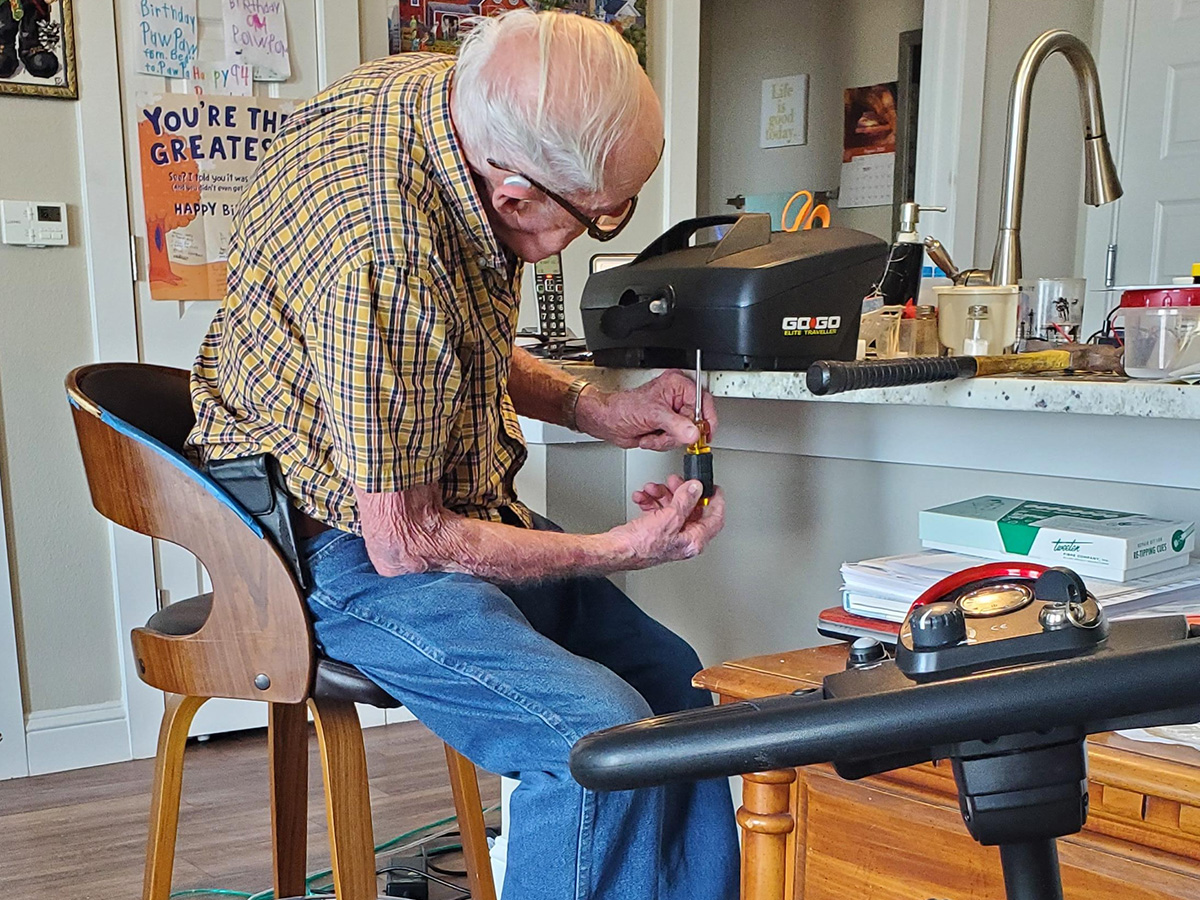
Dad has lived in a retirement community for four years. He’s still quite independent. After our hug, he parked his scooter and settled onto a stool at the bar. I expected him to sit in his favorite chair beside me.
Instead, he adjusted his glasses, grabbed a screwdriver and went to work on the battery box for a scooter.
He explained that he was helping a fellow resident replace the battery. The screws were giving him trouble.
Helping someone was no surprise. Dad has always been a helpful kind of fellow.
The surprise came when he told me he had never tackled this kind of job before. So, he went to YouTube to learn how to do it.
You may not find that surprising. Who among us hasn’t learned something new on YouTube?
But would you expect a 94-year-old to do it?
I was surprised until I remembered that when Dad first moved into the retirement community, people were amazed that he could easily use his iPhone. He’s not afraid of change, either. When a newer iPhone came along, he upgraded.
Dad is still learning. And, more importantly, he is putting what he learns to good use.
That got me thinking about nonprofits and donors.
How do we continue learning when we have been doing something for years? How do we stay curious when we think we already know the answer? And how do we become comfortable with the changes and opportunities that come from learning something new?
Experience is valuable, but it isn’t the finish line
Experience matters. A nonprofit that has served its community for 30 years has accumulated knowledge that a new organization doesn’t have. A donor who has been giving thoughtfully for decades has developed wisdom that comes only through experience. Of course, it can become a problem when it quietly turns into certainty.
“We’ve always done it this way” can be a sign of stability. It can also be a sign that no one is asking whether there is a better way.
Learning does not require us to discard what we know. It asks us to remain curious about what we might not know yet.
For nonprofits, that means continuing to listen to the people they serve. Needs change. Communities change. Technology changes. The ways people communicate, work and solve problems change.
A program that was exactly right ten years ago may need to look different today.
For donors, the same principle applies. The needs we care about can change, and so can our understanding of them. A donor can remain committed to the same values while learning new ways to express those values through philanthropy.
Let curiosity lead
One of the simplest ways to keep learning is to ask better questions.
Nonprofits can ask:
- Are we still solving the problem we think we are solving?
- What are the people we serve telling us?
- What isn’t working as well as it once did?
- What are other organizations learning?
Donors can ask:
- What has changed since I first became interested in this issue?
- What have I learned from the organizations I support?
- What surprised me?
- What could I understand better before making my next gift?
Good questions create room for new information.
And new information creates possibilities.
Learn from what doesn’t work
Learning sounds positive until we realize that sometimes learning comes from something that didn’t go according to plan.
A nonprofit holds an event that doesn’t attract the expected crowd. A grant proposal isn’t funded. A new program doesn’t produce the anticipated results.
A donor supports an approach that turns out to be less effective than expected.
Those moments can be disappointing, but they can also be instructive. The question is not, “Did it work?”
A better question might be, “What did we learn?”
That question changes the conversation from failure to discovery.
Don’t be afraid to try something new
Learning eventually requires action.
Dad could have watched the YouTube video, decided the project looked too complicated and returned the screwdriver to the toolbox. Instead, he learned enough to keep going.
Nonprofits can do the same. They don’t have to reinvent themselves every time something changes. They can experiment. Try something on a small scale. See what happens. Adjust. Try again.
Donors can experiment, too.
They might learn about a new organization, a different approach to giving or a need they had not previously considered. They can ask questions, start small and pay attention to what they learn.
Being willing to try does not mean abandoning good judgment. It’s understanding that certainty is not a prerequisite for progress.
Change can be an opportunity
This brings me back to those road construction zones.
I have driven that route for decades. I know where the turns are. I know where I am going. Yet the road is rarely the same.
Construction changes the lanes. Traffic patterns change. Old routes close.
The road construction means something is changing. Someone decided the road could be improved, expanded or made more useful.
Maybe that is a helpful way to think about changes in our work and our giving.
We don’t have to love every detour. We don’t have to embrace every new idea. But we can become more comfortable asking what the change might make possible.
It means saying, “I don’t know.” Then it means being willing to find out.
The road ahead is still ahead
Dad didn’t need to become an expert in scooter batteries. He needed to solve the problem in front of him.
He encountered something he didn’t know how to do, so he found a way to learn. He put that new knowledge into helping someone else.
At 94, he wasn’t finished learning.
Neither are we.
Not as individuals. Not as nonprofits. Not as donors.
The goal isn’t to know everything. It is to remain curious enough to keep learning, humble enough to change our minds and willing enough to put new knowledge to work.
Because the road ahead will keep changing. Perhaps that isn’t something to fear.
Perhaps it is an invitation to keep learning where it leads.
Read it. Share it. Pass it on.
If you have a question or a topic you would like to see explored in future posts, please reach out to me.
The Gift of Giving by Dawn Franks is a practical, inspiring guide to living with purpose through generosity. Filled with real-world wisdom, it encourages readers to make a meaningful difference and leave a lasting legacy. Click to learn more about The Gift of Giving.
Website: www.dawnfranks.com
Email: dawn@dawnfranks.com
Facebook: https://www.facebook.com/dawfranks/
LinkedIn: www.linkedin.com/in/dawn-franks-strategicsolutions/