
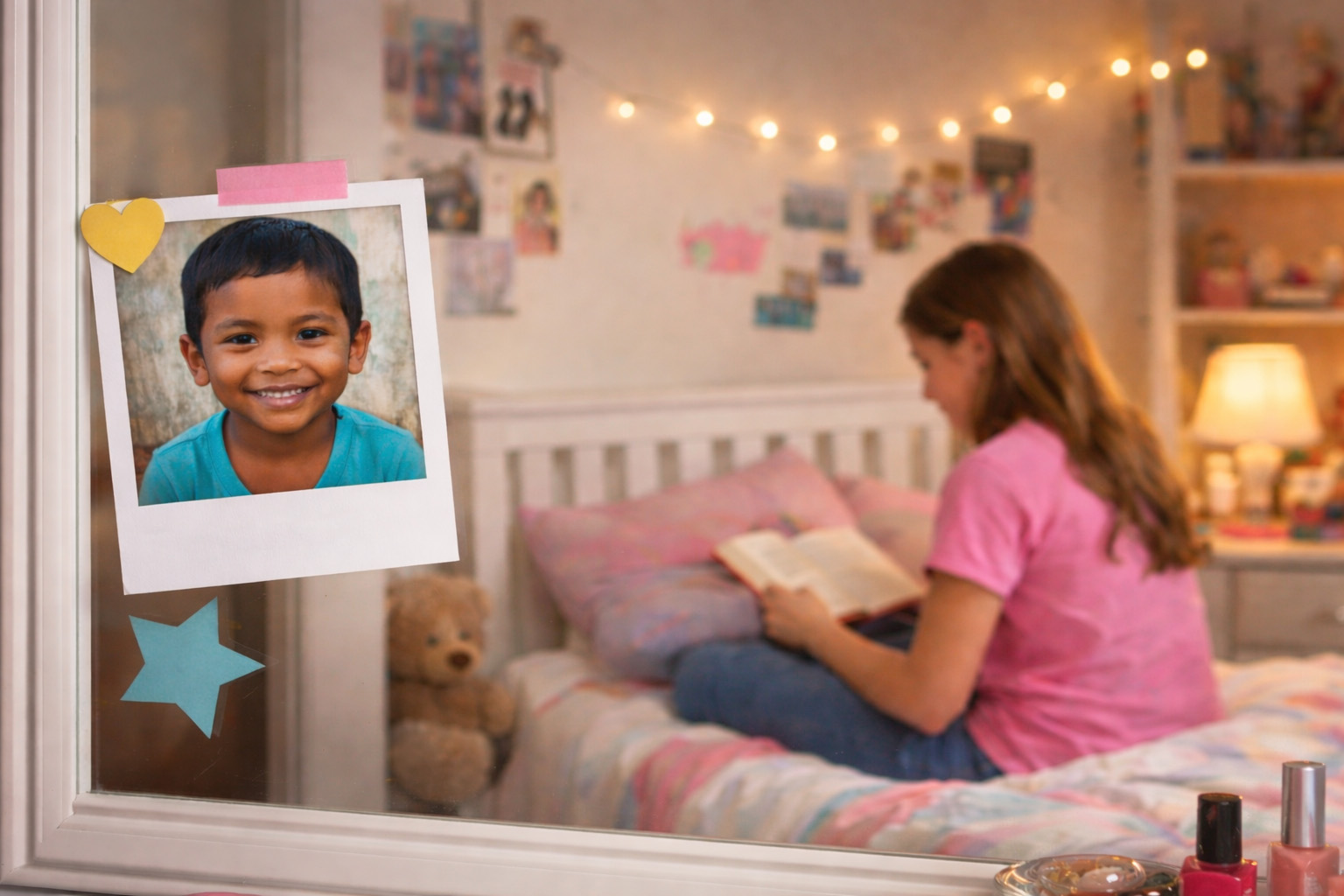
Generosity takes root when parents step back instead of stepping in
How did Woody say it in Toy Story 2?
“I can’t stop Andy from growing up. But I wouldn’t miss it for the world.”
That line captures a feeling every parent knows, watching them grow beyond us. Releasing control, even when we are unsure where they will land, is part of loving them well. And sometimes, it means discovering that the values we hoped to teach take root best when we step back.
Growing up changes all of us
Years ago, a father told me a story that has stayed with me.
When his daughter was young, she announced that she wanted to “adopt a child in another country.” The father, like many well-meaning parents, explained that organizations claiming to do this were often scams and that the money might not actually help the child. He thought the conversation was over.
It wasn’t.
His daughter didn’t argue. She simply went to work. She saved her money and sponsored a child anyway. She taped the child’s photo to her bedroom mirror, where it stayed for years. Life moved on. The daughter grew up, became a mother herself, and today, another child’s photo is on her refrigerator. Now there is a granddaughter in the story too, proud of what she and her mother are doing together.
When children lead the way
What made the story funny was listening to the father describe the slow realization that his daughter had quietly ignored his advice. What made it meaningful was hearing that same father, now a grandfather, describe how proud he was of both her persistence and her generosity.
Harry Truman once said, “I have found the best way to give advice to your children is to find out what they want and then advise them to do it.” I have always loved that line, partly because it sounds too simple to be true, and partly because it so often is.
Trusting the work of the heart
Parents, understandably, worry about raising selfish children in a materialistic world. We look for lessons, programs, and guardrails. But what if generosity isn’t something we can lecture into existence? What if it is something children have to practice in their own way, even when that makes us uncomfortable?
That is why Toy Story still resonates. At its heart, the story is about the shift from ownership to stewardship. Woody’s growth comes when he realizes that love does not mean clinging tightly. It means making room for others, even at the cost of certainty.
Make room for learning
That same shift shows up again and again when we try to teach generosity.
Children are often the moral teachers.
Kids tend to give instinctively to causes, people, and ideas that move them emotionally. Their generosity may not be polished or strategic, but it is often deeply sincere. When we shut it down too quickly, we risk teaching caution instead of care.
Generosity grows through practice, not instruction.
The daughter in this story did not learn generosity because she was told where to give. She learned it by doing: saving, choosing, committing, and living with the relationship that followed. The lesson stuck because it was hers.
Adults must resist controlling the outcome.
This is the hardest part. What if our children give to causes we don’t support? What if they give in ways we would not choose? Truman’s advice still applies. Our role is not to approve every decision. It’s about creating space for learning.
The long view of generosity
I used to ask whether this approach only works with young children. Over time, I have come to believe it may matter even more with adult children.
Here is a simple rhythm I’ve seen work: Ask what they care about and why. Listen without correcting. Encourage them to follow their interests. Wait. Ask what they learned. Listen again.
Then repeat.
Eventually, something surprising happens. The questions begin flowing in both directions. They ask for your perspective. You ask for theirs. It’s circular modeling, learning generosity together over time without needing to be in charge of every step.
The front-row seat to generosity
The father in that original story did not lose his influence by letting go. He gained something better: a front-row seat to generosity taking root across generations.
And that may be the real lesson for parents, grandparents, and all of us trying to do this well. We cannot stop our children from growing up. But we would not miss it for the world. Teaching generosity is not about directing children where to give. It is about trusting them enough to begin.
What are you learning about giving from your children, young or grown? I’d love to hear your story.
Read it. Share it. Pass it on.
If you have a question or a topic you would like to see explored in future posts, please reach out to me.
Website: www.dawnfranks.com
Email: dawn@dawnfranks.com
Facebook: https://www.facebook.com/dawfranks
LinkedIn: www.linkedin.com/in/dawn-franks-strategicsolutions/